NexGPU
Choosing the best data center ai server manufacturer in China requires more than comparing prices or impressive brochures. AI infrastructure must perform reliably under sustained workloads, high heat, and strict uptime expectations. A useful evaluation examines engineering experience, manufacturing control, and support after delivery.
In practice, server quality appears in small details. Check GPU compatibility, PCIe bandwidth, memory capacity, power distribution, and cooling design. A well-built system should maintain stable performance during continuous model training. It should also support practical maintenance, including tool-free access, clear cable routing, and replaceable fans. These details matter when a technician works inside a crowded rack at midnight.
Trust must be demonstrated, not simply claimed. Buyers should request factory evidence, testing procedures, quality certificates, customer references, and realistic delivery records. They should also confirm firmware support, warranty terms, spare-parts availability, and remote troubleshooting processes. An experienced data center ai server manufacturer can explain these points clearly and provide measurable specifications.
However, no supplier is perfect. Some product pages may simplify thermal limits or present peak benchmark results without operational context. That deserves closer review. Independent validation, sample testing, and a small pilot deployment can reveal weaknesses before a large purchase. The strongest manufacturer is not always the cheapest or the most famous. It is the partner that communicates honestly, documents performance, and continues supporting the infrastructure after installation. Reliability takes time.
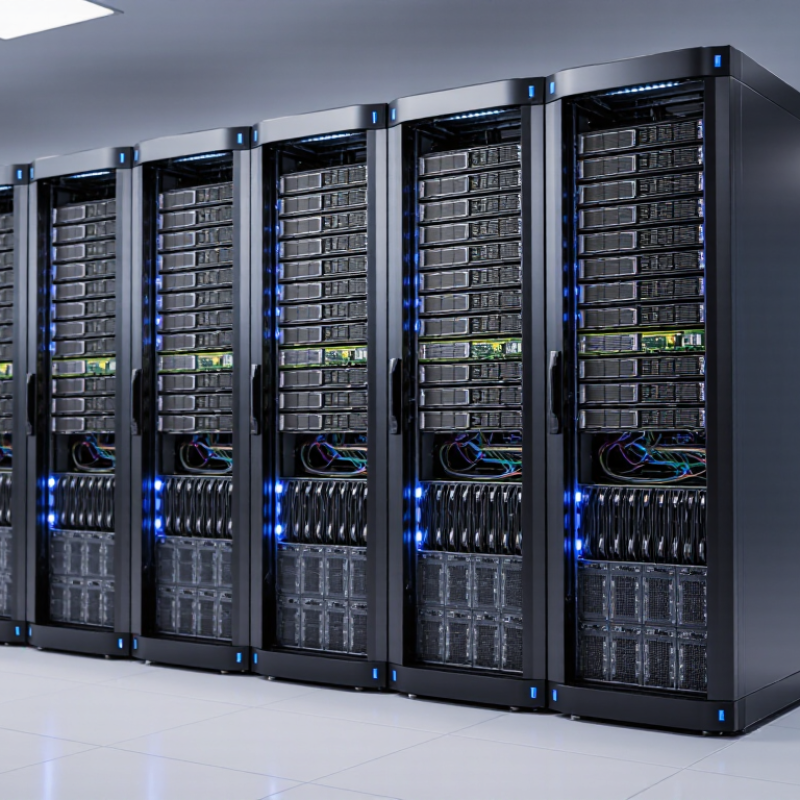
China Best Data Center AI Server Manufacturer?
A data center AI server manufacturer does more than assemble processors, memory, and storage. It designs a complete computing platform for sustained, high-density workloads. This includes motherboard engineering, power delivery, thermal control, firmware, rack integration, and lifecycle support. The definition matters because AI servers often operate continuously under heavy accelerator loads. A small airflow mistake can create thermal throttling within minutes.
The International Energy Agency reported that data centers consumed about 415 TWh of electricity in 2024. It expects this figure to exceed 945 TWh by 2030. These numbers make efficiency a manufacturing responsibility, not a marketing phrase. A qualified manufacturer should publish power testing methods, acoustic limits, cooling requirements, and performance results under realistic workloads. Uptime Institute’s 2024 Global Data Center Survey also identifies power-related issues among the leading causes of serious outages. Therefore, redundant power design and serviceable components deserve close inspection. A strong supplier should provide burn-in testing, firmware traceability, remote diagnostics, and clear replacement procedures. Certifications help, but they cannot replace field evidence. No factory gets every deployment right. Buyers should question thermal claims, request independent test records, and examine failure-response times. Rack density, regional maintenance capacity, and technician training can matter more than peak benchmark scores.
A data center AI server manufacturer designs and produces rack-mounted computing systems optimized for artificial intelligence workloads. The chart compares standardized rack-unit heights commonly used for AI server configurations. One rack unit (1U) equals 44.45 millimeters in height; larger systems provide more physical space for accelerators, memory, storage, networking, cooling, and power delivery.
Evaluating Chinese AI server manufacturers requires more than comparing processor counts. Start with documented engineering experience in high-density data centers. Ask for thermal test records, power measurements, and workload results under sustained use. Reliable manufacturers explain cooling design, rack compatibility, and component traceability. They should also provide clear firmware controls and security update procedures. Marketing claims alone are not enough.
Tips: Request a factory audit or live production video. Check independent certifications and recent customer references. Compare warranty terms, replacement times, and technical support coverage. Test one sample server before placing a large order. Small details matter, such as cable labeling and fan noise.
Supply reliability deserves equal attention. Review inventory policies, delivery history, and backup component plans. A professional supplier should identify possible delays before signing an agreement. It should also explain how failures are diagnosed remotely and on site. I would not judge quality from appearance alone. No evaluation is perfect. Even experienced buyers can overlook software compatibility, energy costs, or regional service limits. A written acceptance test can reduce that risk. Look for measurable commitments, not impressive promises.
Leading Chinese Data Center AI Server Manufacturers
Chinese data center AI server manufacturers now serve research labs, cloud platforms, universities, and industrial customers worldwide. Their strongest advantage is manufacturing depth. They can combine accelerator support, high-density chassis design, and large-scale production within one supply chain.
In server evaluations, I look beyond processor specifications. A reliable manufacturer should explain thermal limits, power redundancy, firmware updates, and component traceability. Liquid cooling deserves close attention. A rack drawing may show impressive density, yet real performance depends on pumps, coolant paths, and maintenance access. Small details matter.
Ask for validation reports, burn-in records, and clear warranty terms. Check whether the supplier has experience with your workload, rack design, and regional electrical standards. Good technical teams discuss failure rates honestly. They also explain what their platform cannot do. That builds trust.
Performance is not everything. A server that consumes excessive power can weaken a data center’s operating budget. Noise, service time, spare parts, and remote monitoring also affect long-term value. Some manufacturers offer excellent customization, but this can create delays and compatibility risks. I have seen attractive specifications lose importance during deployment. The lesson is simple: review the complete system, not only the AI accelerator. Independent testing remains useful, because supplier data may present the best-case result rather than daily performance.
Brand-neutral comparison framework for evaluating data center AI server manufacturers in China. The specifications below reflect commonly deployed enterprise AI server configurations and internationally recognized data center requirements.
| Evaluation Dimension | Standard Enterprise AI Server | High-Density AI Server | Rack-Scale AI Platform | Recommended Verification Point |
|---|---|---|---|---|
| Typical Form Factor | 1U–2U rack server | 4U–8U GPU server | Multiple servers integrated in a rack | Rack compatibility, service clearance, and total rack weight |
| Accelerator Capacity | 1–4 accelerator cards | 4–8 accelerator cards | Distributed accelerator nodes with fabric connectivity | Supported accelerator type, thermal design power, and interconnect topology |
| Host CPU Platform | Single- or dual-socket x86 or Arm server architecture | Dual-socket enterprise CPU architecture | Multi-node CPU and accelerator architecture | CPU-to-accelerator bandwidth, NUMA layout, and operating-system support |
| Memory Capacity | 256 GB–2 TB system memory | 512 GB–4 TB system memory | Several terabytes across multiple nodes | Memory type, expansion slots, error correction, and maximum validated capacity |
| Accelerator Interconnect | PCIe-based host connectivity | PCIe Gen4 or Gen5, with optional direct accelerator links | Dedicated high-speed scale-up and scale-out fabric | Peer-to-peer bandwidth, latency, topology, and fabric management |
| Network Connectivity | 10GbE–25GbE management and data networking | 25GbE–100GbE data networking | 100GbE–400GbE Ethernet or equivalent high-speed fabric | Network adapter compatibility, congestion control, and switch support |
| Storage Configuration | NVMe SSDs for operating systems and local datasets | Multiple NVMe drives with RAID or software-defined storage | Local NVMe cache plus shared high-performance storage | Drive hot-swap capability, RAID support, endurance rating, and storage throughput |
| Cooling Method | Air cooling | High-pressure air cooling or hybrid cooling | Direct-to-chip liquid cooling or rear-door heat exchange | Cooling capacity, facility water requirements, leak detection, and maintenance process |
| Power Design | Redundant hot-swappable power supplies | High-wattage redundant power supplies | Rack-level power distribution and redundancy planning | Input voltage, peak power, power efficiency, and data center power density |
| Management Features | Out-of-band management and hardware monitoring | Remote firmware, accelerator, and thermal monitoring | Rack-level telemetry, orchestration, and centralized lifecycle management | Redfish or equivalent API, audit logs, alerting, and firmware update controls |
| AI Workloads | Inference, model development, and small-scale fine-tuning | Large-model inference, fine-tuning, and departmental training | Distributed training, large-model serving, and AI cloud infrastructure | Measured performance using the customer’s model, batch size, precision, and dataset |
| Software Compatibility | Linux, virtualization, containers, and standard AI frameworks | Container orchestration and multi-GPU software stacks | Cluster schedulers, distributed training frameworks, and infrastructure APIs | Driver versions, container images, Kubernetes support, and software validation reports |
| Reliability Design | ECC memory, redundant fans, storage protection, and hot-swap components | Enhanced thermal, power, and accelerator fault monitoring | Cluster-level failure isolation and workload recovery | Burn-in testing, failure-rate data, spare-parts policy, and service procedures |
| Compliance and Certifications | Applicable safety, electromagnetic compatibility, and environmental certifications | Certification coverage for high-power computing equipment | System-level compliance documentation for complete rack deployments | Request certificates, test reports, regional approvals, and material declarations |
| Customization Capability | Memory, storage, networking, and firmware configuration | Chassis, GPU layout, power, cooling, and operating-system customization | Rack integration, liquid cooling, networking, orchestration, and deployment services | Engineering resources, validation process, documentation, and change-control capability |
| Best-Fit Buyer | SMB, enterprise department, laboratory, or inference deployment | Research institution, private cloud, or AI development team | Cloud service provider, large enterprise, or AI data center operator | Match the platform to workload scale, facility capacity, service model, and budget |
Note: Actual performance, availability, delivery time, and total cost depend on the selected accelerator configuration, software stack, facility environment, and service agreement. Vendors should be compared using identical workloads and independently verifiable test results.
China’s leading data center AI server manufacturers focus on more than accelerator counts. Their products combine high-performance CPUs, AI accelerators, fast memory, and flexible PCIe expansion. A practical server should support model training, inference, and mixed enterprise workloads. It also needs stable firmware and clear remote management tools.
Cooling design strongly affects real performance. Air cooling suits moderate deployments, while direct liquid cooling handles dense racks more efficiently. Power supplies should support redundancy and intelligent load balancing. High-speed networking, RDMA, and container orchestration help servers exchange data with less delay. In field evaluations, I check sustained performance, noise, thermal stability, and maintenance access. Short benchmark results can mislead.
AI server applications continue to expand across manufacturing, medical imaging, finance, energy, and scientific research. Factory systems can inspect tiny surface defects through real-time vision models. Hospitals may use accelerated inference to assist image analysis, with professional review still required. Financial teams can process risk models faster, but data governance remains essential. Energy companies use AI servers for forecasting and equipment monitoring.
No design is perfect. A powerful server may waste energy under light workloads. A compact chassis may complicate repairs. Some systems also require specialized engineering support after installation. Buyers should compare total operating cost, software compatibility, warranty response, and upgrade paths. Those details often matter more than peak theoretical speed.
Selecting the best China-based AI server manufacturer starts with your workload, not a sales brochure. Define GPU type, memory capacity, networking speed, rack density, and expected training hours. The IEA’s Electricity 2024 report estimates that data centers used about 460 TWh globally in 2022, with demand potentially reaching 620–1,050 TWh by 2026. Cooling efficiency matters.
Ask manufacturers for measured performance, not theoretical specifications. Request thermal test records at full load, burn-in procedures, failure rates, and power usage effectiveness assumptions. Uptime Institute’s 2024 Global Data Center Survey identifies power availability and capacity as major operational concerns. Therefore, verify liquid-cooling compatibility, redundant power design, firmware control, and replacement-part availability. Small details matter.
Visit the production site if possible. Check component traceability, testing equipment, quality certifications, and technician response times. Ask for references from deployments similar to yours, preferably with comparable rack power and network traffic. A low purchase price can look brilliant on paper. It can also become an expensive mistake. Evaluate total cost over three years, including electricity, maintenance, software support, shipping, and downtime. A manufacturer may offer impressive benchmarks but weak after-sales service. That gap deserves uncomfortable questions. Choose the supplier that can document performance, explain limitations clearly, and adapt the server platform to your actual data center conditions.
It should handle model training, inference, and mixed enterprise workloads. Look for strong CPUs, accelerators, fast memory, and flexible expansion. Remote management matters. So does stable firmware.
Cooling controls sustained performance, noise, and component stability. Air cooling suits moderate workloads. Direct liquid cooling fits dense racks. A cool chassis is not automatically efficient.
Choose redundant power supplies with intelligent load balancing. Ask about full-load power consumption and thermal behavior. Power availability can limit operations. Peak performance means little during outages.
High-speed networking reduces data transfer delays. RDMA can improve communication between servers. Container orchestration supports flexible deployment. Test actual traffic, not only connection speed.
Begin with your workload requirements. Define accelerator type, memory, rack density, network speed, and training hours. Request measured results. Brochures can exaggerate.
Ask for thermal tests at full load, burn-in procedures, failure rates, and power assumptions. Request component traceability and quality records. Missing documents deserve uncomfortable questions.
Check testing equipment, technician response times, and replacement-part availability. Review similar deployments with comparable rack power and network traffic. A clean facility proves little alone.
Compare electricity, maintenance, software support, shipping, upgrades, and possible downtime over three years. A low purchase price may become expensive. I might still underestimate repair delays.
Manufacturing systems can inspect tiny surface defects in real time. Medical imaging may receive inference assistance, with professional review required. Energy teams can forecast demand and monitor equipment. Financial applications still require careful data governance.
Choosing the best data center ai server manufacturer requires more than comparing hardware specifications. A reliable manufacturer should demonstrate strong capabilities in server design, AI acceleration, thermal management, power efficiency, system integration, quality control, and long-term technical support. Evaluation should also consider product scalability, compatibility with mainstream computing platforms, supply stability, customization options, certifications, delivery capacity, and total cost of ownership.
Leading Chinese manufacturers serve diverse applications, including cloud computing, scientific research, intelligent manufacturing, financial analysis, healthcare, transportation, and large-scale data processing. Their AI server solutions may combine high-performance processors, accelerator cards, advanced storage, high-speed networking, and intelligent monitoring technologies. To select the right partner, buyers should clearly define workload requirements, performance targets, deployment environment, budget, maintenance expectations, and future expansion plans. A careful comparison of technical strength, service responsiveness, product reliability, and project experience can help organizations identify a suitable manufacturer for secure, efficient, and sustainable AI infrastructure.
